
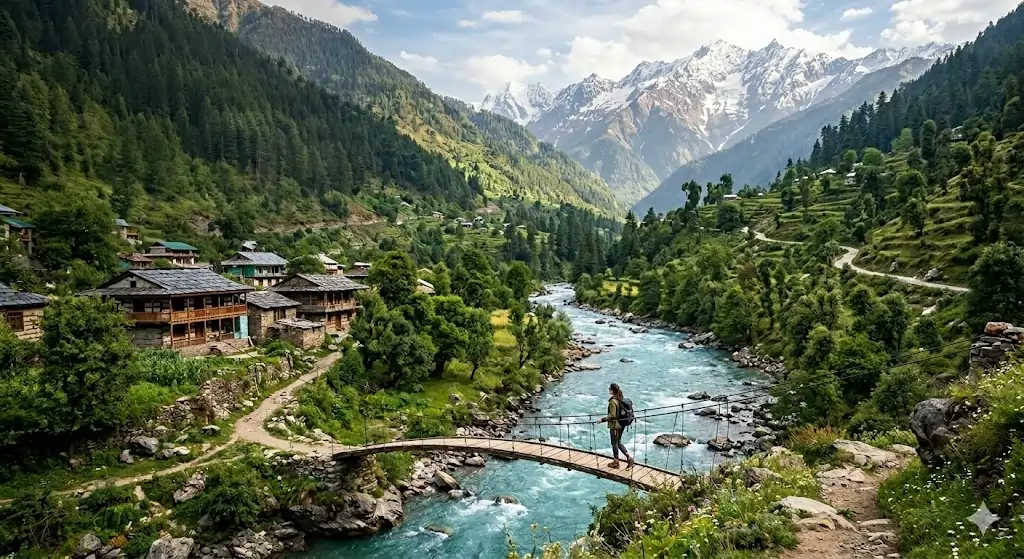
Tirthan Valley in 2026: What to Actually Know Before You Go
If you’ve done Manali twice and Kasol once and you’re now looking for something that doesn’t feel like a repeat, Tirthan is the honest answer. Not because it’s undiscovered, it isn’t anymore. But because it’s still far enough from the Manali circus that the experience feels different.
Here’s what the other guides won’t tell you upfront: technically, there is no valley called Tirthan. The region is called Seraj. Tirthan is the river. Somewhere along the way, tourists started calling it Tirthan Valley and the name stuck. It’s a small thing, but it tells you something about how this place gets written about.
This guide skips the basics you already know and gets into the specifics that actually matter.
The honest state of it in 2026
Tirthan is not a secret anymore. It started appearing on Instagram around 2019 and hasn’t looked back. April to June now brings real crowds to Gushaini, the main base village. Good luck finding a riverside homestay in May without booking six weeks ahead.
That said, the valley is long and most tourists don’t go far. The crowd concentrates around Gushaini bridge and the few cafes nearby. Walk 20 minutes upriver or drive towards Pekhri or Sarchi and you’re past most of it. The people who complain Tirthan has become touristy are usually the ones who stayed in the most obvious spot during peak season and expected an empty valley.
September to November is the correct answer if you want space and decent weather together. March and early April work too, though it can be cold in the mornings and the higher trails may still have snow.
Getting there without the usual confusion
The part that trips people up: when driving from the Chandigarh side, you’ll hit the Aut tunnel on NH3. Do not go through it. Just before the tunnel entrance, there’s a smaller road on the right. Take that. It crosses a dam, then a bridge, puts you through Larji, and from there it’s a straight 20 km to Banjar. First-timers miss this turn and end up adding an unnecessary hour.
From Chandigarh, the drive is 6 to 7 hours in normal conditions. From Delhi, budget 11 to 12 hours. The road from Aut to Banjar is fine. Beyond Banjar towards Gushaini and further, it gets narrower. Nothing a regular car can’t handle, don’t try it in the dark if you’re not familiar with mountain roads.
If you’re coming by bus, the Volvo from Kashmere Gate ISBT to Aut is the standard move, costing around Rs. 800 to Rs. 1,200. Leaves in the evening, reaches Aut by early morning. From Aut, shared cab to Gushaini is around Rs. 800 to Rs. 1,200. That’s the budget route, and it works fine.
One navigation note for first-timers to the area: Google Maps marks Tirthan Valley at Sharchi, which is near the end of the road into the valley. If you search for that, you’ll overshoot your actual destination by 15 to 18 km. Search for Gushaini instead.
Also read: Weekend Getaways Near Chandigarh: Quick Escapes for 2026
Where to actually stay
Most homestays sit along or near the river. The ones closest to the Gushaini bridge are convenient but also the loudest in peak season, with other tourists around constantly.
For the experience most people are actually looking for, push further. Homestays in Pekhri and Sarchi cost similar rates but feel genuinely different. You’re surrounded by apple orchards instead of other travellers. The family cooking your dinner is not doing it for twenty guests.
Budget range (Rs. 1,000 to Rs. 2,500 per night): Gushaini has several small guesthouses near the bridge. Functional, nothing more. Tirthan Valley Luxmi Homestay gets consistent reviews and has WiFi if that matters to you.
Mid-range (Rs. 2,500 to Rs. 5,000 per night): Himalayan Trout House is the known name here, riverside, and good if you actually plan to fish. Tirthan Riverside Camps if you want the bonfire tent setup. NotOnMap – The Lost Escape works well for couples.
Worth knowing: Most homestays include meals in the rate. Confirm before booking. The homemade food is usually the best thing about the stay, especially at smaller family-run places further from Gushaini.
Jio and Airtel both work reasonably in Gushaini. Past Pekhri, expect it to get patchy. There’s an ATM in Banjar. Carry cash into the valley.
What to do, without the padding
The GHNP trek
This is the main reason serious travellers come here. The Great Himalayan National Park is a UNESCO site and the access point at Sai Ropa is about 4 km from Gushaini. You need a permit (Rs. 200 to Rs. 500 depending on the trek) and a mandatory guide hired from the forest department cooperative at Sai Ropa.
The popular entry-level route goes to Rolla meadow, a 3 to 4 day trek. The Shilt Huts route goes higher and takes longer. Both are legitimate wilderness experiences. The guide requirement is genuine, not a bureaucratic formality. The park is large, trails aren’t marked, and the guides are locals who know what’s actually out there.
We went in on the Rolla trail on a mid-October morning. Cold enough that breath was visible. The guide had been doing this for years and pointed out a Himalayan Monal in the first hour that we’d completely missed. Three hours in, there was no sound except the river below and whatever birds the guide could name faster than we could look. It’s the kind of forest that makes you realise how much noise you’ve been living with.
Trout fishing
The Tirthan River runs clear enough that you can see the fish before you cast. You need a permit from the Fisheries Department in Banjar, around Rs. 100 to Rs. 300 per day. The fishing is catch-and-release mostly, which is the right call for the river’s health.
We spent an afternoon on a flat stretch of bank about 20 minutes upriver from the homestay. Caught nothing significant. Didn’t matter. Sitting on the rocks watching the water is not a consolation prize.
Chhoie Waterfall
A 2.5 to 3 hour walk from Gushaini through forest. No entry fee. Best in spring when the water is strong. Go early morning. The forest section before the waterfall is genuinely quiet and good on its own terms, not just as a means to the waterfall at the end.
Jalori Pass and Serolsar Lake
30 km from Gushaini by road, roughly an hour’s drive. The pass sits at 3,120 metres and is motorable, which makes it accessible to people who wouldn’t otherwise get to that altitude easily.
From the pass, the trek to Serolsar Lake is 3 km each way through oak and cedar forest. The lake is sacred locally and sits at the tree line. Quiet, cold, worth it.
One reviewer noted the lake itself is underwhelming if you’re expecting dramatic alpine scenery. That’s fair. The value here is the forest walk and the views from the pass, not the lake as a destination in itself.
We drove up early enough to have the pass to ourselves for about 40 minutes before the first other vehicle arrived. That window matters. Get there before 9 AM.
Jalori Pass closes in heavy snow, typically from December through parts of February. Check conditions before planning around it.
Village walking
This costs nothing and is underrated in every guide because it can’t be packaged. Pekhri and Nagini are both worth wandering through slowly. Chehni Kothi in the Banjar Valley is a 1,500-year-old stone tower, originally a fortress, now a temple, accessible via a forest trail. Most visitors miss it entirely.
We spent an afternoon walking through Pekhri with no agenda. A woman sitting outside her house offered us apples from a basket she’d just carried in. We stood there eating apples and looking at the mountains for ten minutes. That kind of interaction doesn’t happen in Manali anymore.
Food
Most meals will be at your homestay or at small dhabas in Gushaini. The food is Himachali, simple, and usually good.
Siddu is the thing to eat: steamed wheat bread stuffed with poppy seed paste or walnuts, served with ghee and green chutney. Available at small dhabas for Rs. 50 to Rs. 100. Madra, a chickpea curry made with yoghurt gravy, shows up at homestay dinners and is better than it sounds. If your homestay offers trout, order it.
Budget Rs. 200 to Rs. 500 per day for food outside meals included in your stay rate.
A 3-day plan that actually works
Day 1: Reach Gushaini by noon from Chandigarh, check in, walk the river in the afternoon, sort your GHNP permit timing for the next day, eat at the homestay.
Day 2: Early start to Sai Ropa, guided trek into GHNP half-day. Afternoon: Chhoie Waterfall if you have energy, or the river otherwise.
Day 3: Leave Gushaini by 7 AM for Jalori Pass. Reach by 8 to 8:30. Trek to Serolsar Lake, back to the pass by noon. Drive down, stop in Banjar, buy honey or walnuts, drive back. Evening village walk if you’re not done yet.
Day 4: Leave by 9 AM to reach Aut comfortably for buses or onward travel.
The honest verdict
Tirthan is worth it, with expectations calibrated correctly. It’s not an empty valley anymore. It’s not going to feel discovered. But it still has the river, the forest, the food in the homestays, and the roads that thin out the further you go.
Go in October if you can. Book early if you’re going in May. Push past Gushaini regardless of when you go.
FAQ
Is it safe for solo female travellers?
Generally yes. The valley is conservative but not hostile. Stick to known homestays, tell someone where you’re going each day, and don’t trek into the forest alone without a guide.
December and January?
The valley floor and Gushaini stay accessible. Jalori Pass will likely be closed. Cold, around 5 degrees or below. Quiet in a way that either appeals to you or doesn’t.
How many days minimum?
3 nights. Less than that and you’re rushing through everything.
Combine with Kasol or Kheerganga?
You can, but they’re in different valleys and require going back to Bhuntar. Makes sense for a 7 to 10 day Himachal trip, not a short one.
About the Author: Antra Sonkhla

editor's pick

news via inbox
Nulla turp dis cursus. Integer liberos euismod pretium faucibua